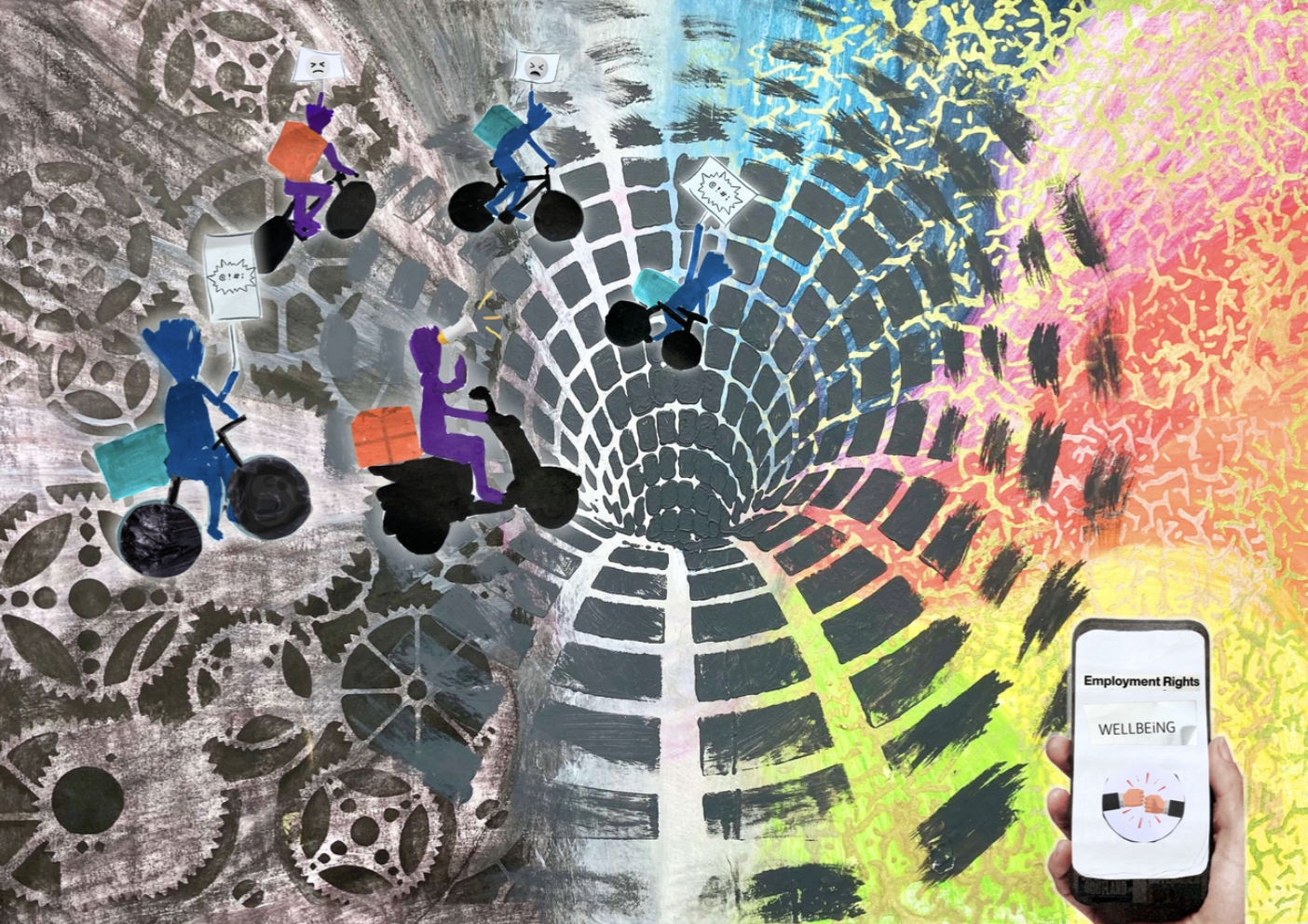
Image Attribution: Sophie Valeix & Digit / https://betterimagesofai.org / https://creativecommons.org/licenses/by/4.0/
In November 2025, India’s four Labour Codes went into effect. Of the four, The Code on Social Security, 2020, was the one that discussed platform and gig work. Recently, the government also introduced the draft Code on Social Security (Central) Rules, 2025. The two developments carry serious safety net, welfare and data implications for the platform economy, alongside the country’s wider labour landscape.
As part of a joint undertaking to provide comments on the draft rules, Aapti Institute developed a set of recommendations, consisting of broad commentary on the provisions alongside targeted responses to specific rules. Our comments focus on issues like the eligibility requirements, updating worker information, the worker data required and its use, and the process of registration. Workers’ registration should be easy, social security should be available sooner rather than later, and the data involved should be clearly defined in its scope and usage. Some of the overarching comments that were prepared our provided below:
- Shorten gig workers’ eligibility time periods: Similar to how gig workers immediately start taking on work (and by extension, risk), platforms and welfare institutions need to make available social security measures as soon as possible. 90 to 120 days of gig work (as discussed in 49 (2) (e)) is a prolonged period of risk within which the worker could very well face a situation where they will need services like insurance. Rather than exclusively going by the number of days, which depends on platforms offering gigs, we should consider the number of hours spent online, combining time spent on gigs with “waiting time.”
The state should also consider making eligibility criteria depend on the sector and onset of personal risks for workers. Should a platform’s consumer advertising or algorithmic management involve time constraints on workers (like ten-minute deliveries for consumer goods), then social security for workers on that platform should be made available from the first gig. - Penalize firms for negligence affecting worker eligibility: Workers should not lose access to much-needed social security measures as a result of companies not updating registration information (as discussed in 49 (2) (h)). This adversely affects workers rather than companies for inadequate compliance. To incentivize registration and updation, aggregators should be made to pay for any injuries and social security needs in the period where a worker is ineligible due to aggregators’ lack of updation.
- Provide multiple options for worker registration: Making Aadhaar one of the main documentation required for registration (49 (1) (b)) can create barriers and difficulties for workers. Workers should have multiple options for the kinds of documentation they can submit for enrollment to social security.
- Consider decentralized social security governance: Social security is a product of not only platforms’ initiatives and gig-economy-specific undertakings but also existing programmes and market offerings. Something to consider is whether social security services can be decided upon by more local state actors and worker representatives.
- Outline the worker data involved: In portions like 49. (2) (b), the rules should outline the kind of worker information that will be provided to the government. This will provide a baseline of how much information workers have to provide to platforms and to the government.
- Clarify the utility of the Universal Account Number: While the UAN positions itself as a unifying identifier for gig and platform workers, its utility under the draft rules remains limited. Without defined functions and features, the UAN risks duplicating existing identifiers while adding an additional compliance layer for workers. To make the UAN framework more robust, the rules should explicitly state the functions and rights associated to the UAN, ensure automatic portability of eligibility and contributions across aggregators, prevent deactivation or dormancy of the UAN due to inactivity or platform-level disputes and enable workers to access, correct and update their records linked to the UAN. Given the high prevalence of migration among unorganised, gig, and platform workers, the UAN should facilitate seamless transfer and regular updation of worker data, and ensure that social security benefits remain accessible to workers in the state where they are operating at any given time.
- Explicitly state the purpose of worker data: On top of discussing the kinds of information the state receives from platforms, certain restrictions on what this data will be used for should also be implemented.
While the needle on social security has moved, the state will also have to face the issues
of algorithmic management, transnational outsourcing of tasks and gigs, and the growing online gig economy.
The comments were part of a collaborative initiative consisting of numerous people and organizations, including but not limited to the Telangana Gig and Platform Workers Union (TGPWU), Social Accountability Forum for Action Research (SAFAR), and IT for Change. Aapti Institute provided a part of the comments, and the final document, which can also be found here, is provided below.