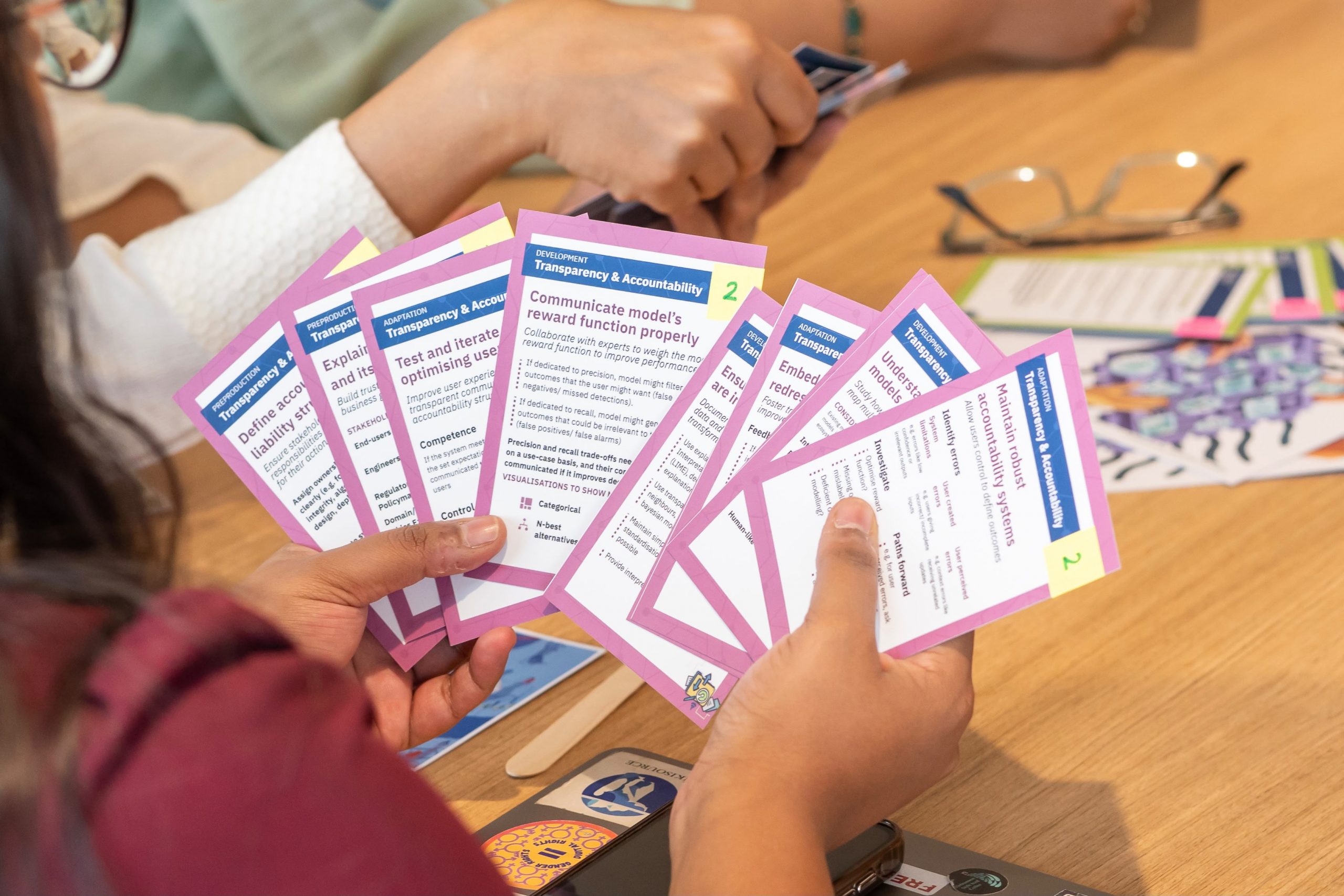
Credit: Australian Consulate-General Bengaluru
Interacting with games
When I first played a game that let me be India’s Finance Minister and showed me how my budget allocation compares to the actual Union Budget 2026–27, I did not expect to be called the “RBI governor’s worst nightmare.”
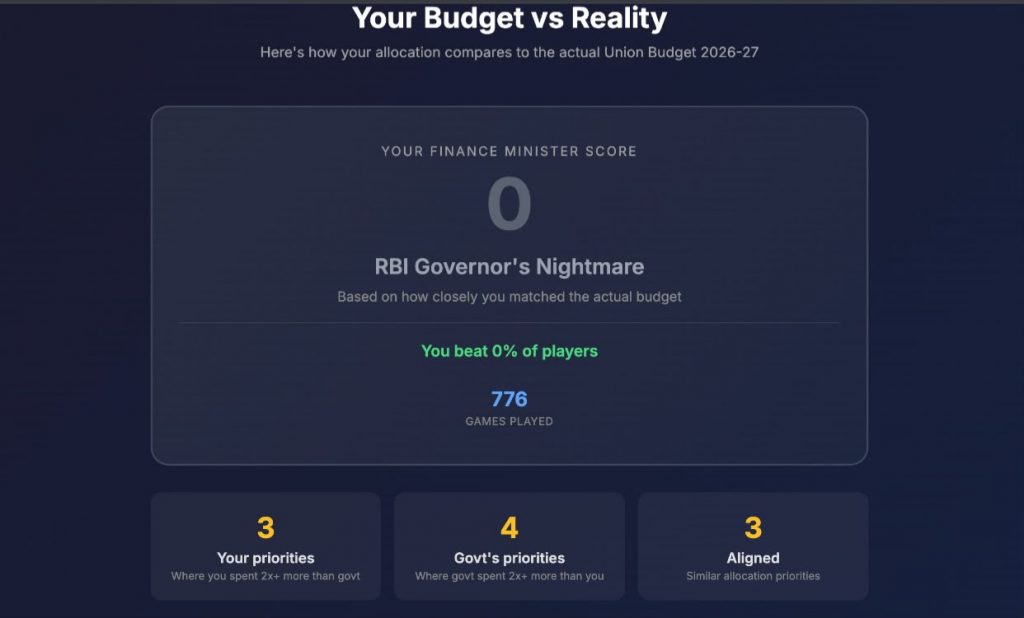
Image source: Madhavi Jain
Description: Screenshot of the results screen from If You Were Finance Minister by Prakhar Singh, displaying the author’s performance metrics.
Turns out, my allocated annual GDP expenditure on health and education were 9x more than the Indian government’s. Even post the covid-19 pandemic, India was spending about 2% of its GDP on healthcare — one of the lowest among G20 nations. Designed by a public policy professional, Prakhar Singh, this digital economy and policy simulator let the player decide what they did with approximately ₹53 lakh crore, roughly the same as India’s Union Budget for the year 2026-27. The data to build this simulator was also taken directly from the Indian government’s union budget website – making it relatively grounded in the real world.
The game allowed players to allocate the entire Union budget across 10 major categories including health, education, defense, agriculture, and transport using sliders. Then, they were scored based on how closely their choices compared to the actual budget allocation. The higher your score, the more you are theoretically in tune with the government’s budgetary allocations.
What the game enabled, however, was far more interesting. Regardless of how well-versed one was with the updates and intricacies of the country’s annual budget breakdown, the game clearly provided important statistics on federal spending in a way that cut through the data and ‘number heavy’ reporting on major news platforms. It did a comparative analysis of my priorities vis-a-vis the government’s, which for me, was far more consequential in understanding the relationship between me, as a citizen, and the state. It also put things in perspective for me — I had allocated a whopping 23.6% of the GDP to education, while the government allocated only about 3% of the GDP to it, lower than even the NEP-recommended 6%, and far lower than a majority of global leaders like USA, UK, and Germany.
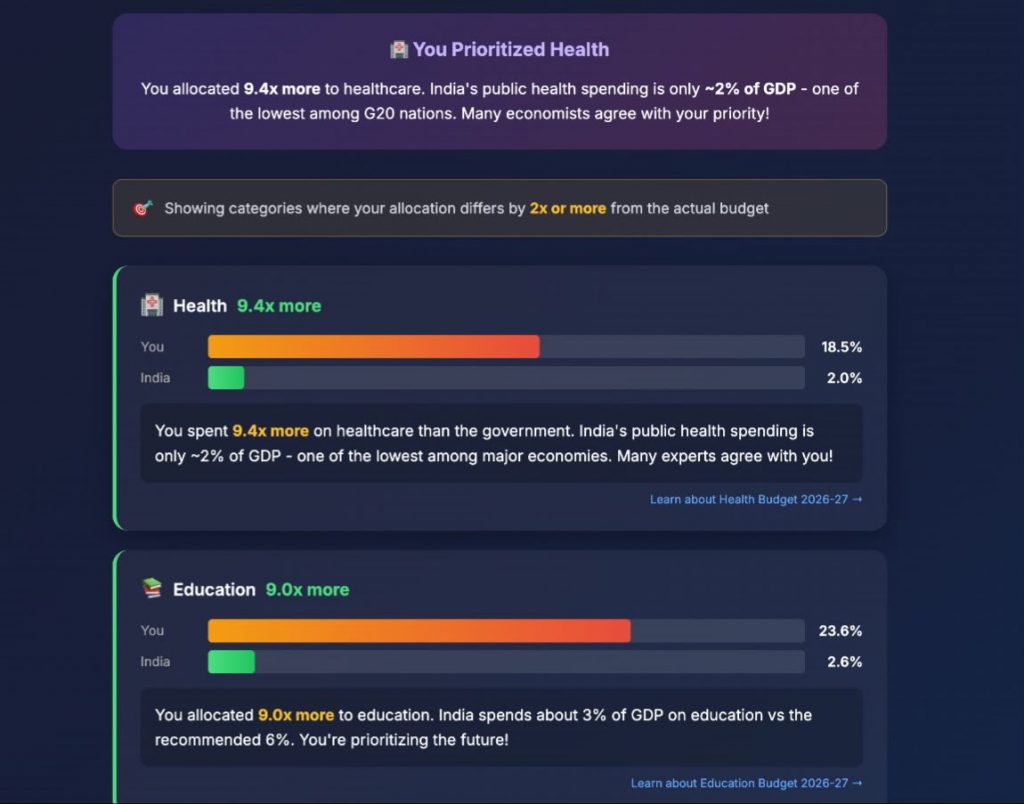
Image source: Madhavi Jain
Description: Screenshot of the results screen from If You Were Finance Minister by Prakhar Singh, displaying the author’s performance metrics.
Earlier this year, we found ourselves involved in many conversations surrounding AI, sparked by the India AI Impact Summit 2026. The summit marked a pivotal moment in India’s AI governance journey, bringing together global leaders and tech giants to discuss AI scaling on the world stage. Inside the event rooms of Bharat Mandapam in New Delhi, negotiations unfolded as countries engaged in the familiar push and pull to advance their interests.
For those of us following these developments largely through the internet, Civic Games Lab designed an interesting simulation: A game where you played as the National AI Advisor of a developing nation. As the global AI race accelerated, the game sought to decide whether “you have a seat at the table, or are you the menu?” by asking the player to make 15 decisions, across five arenas: compute, data governance, talent, start-ups, and geopolitical strategy.
Yet again, I fared poorly. The simulation rendered my commons-first choices irrelevant by stating that the summit opened without me. It even went so far as to roast me: “The agenda was set without you”, “you will be consulted, not heard”, and “your country appears on page fourteen, paragraph three, as a “partner economy with significant AI potential.”
In comparison, more market driven choices meant more relevancy for the player’s country on the global scale. This was one of the easiest ways to understand the fine line that countries must tread, should they want to make their presence felt on world stages like the AI summit. Nonetheless, I was content with my choices and relieved to not be the one carrying out the tough balancing act.
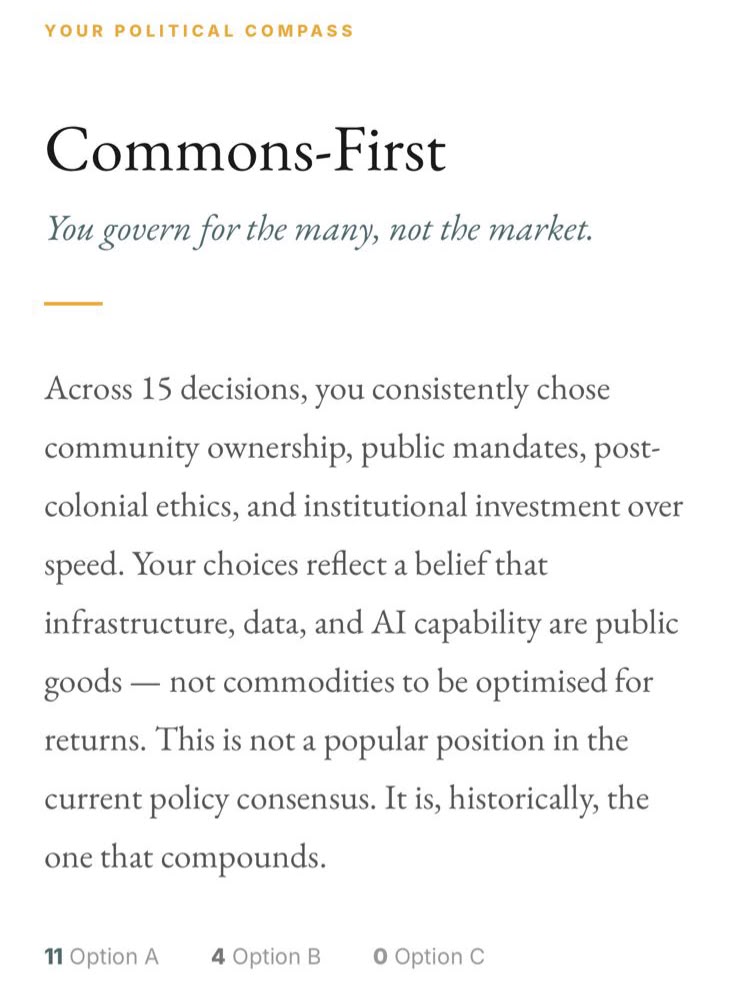
Image source: Madhavi Jain
Description: Screenshot of the results screen from AI Race: An AI Governance Simulation by Civic Games Lab, displaying the author’s performance.
Leveraging play
Play is powerful. By being interactive, fun and challenging, it unlocks agency in people to bargain their participation—and the extent of it—in any given scenario. Recently, at Aapti, we’ve been thinking about the power of games to translate policy and research into impact. In many of our games, although played offline, play works in three steps: it surfaces hidden mindset barriers, brings them into focus, and then helps address and shift them.
Over the last few years, Aapti has attempted to use games as a methodology that works on the principles of knowledge, capability and ease. We’ve created multiple different games on topics ranging from negotiating justice, responsible AI, the harms of AI labour and online scams and even hosted game workshops in both private and public spheres like Infosys, Science Gallery Bengaluru, AI DevCon, and with the Australian Department of Foreign Affairs and Trade, both globally and domestically.
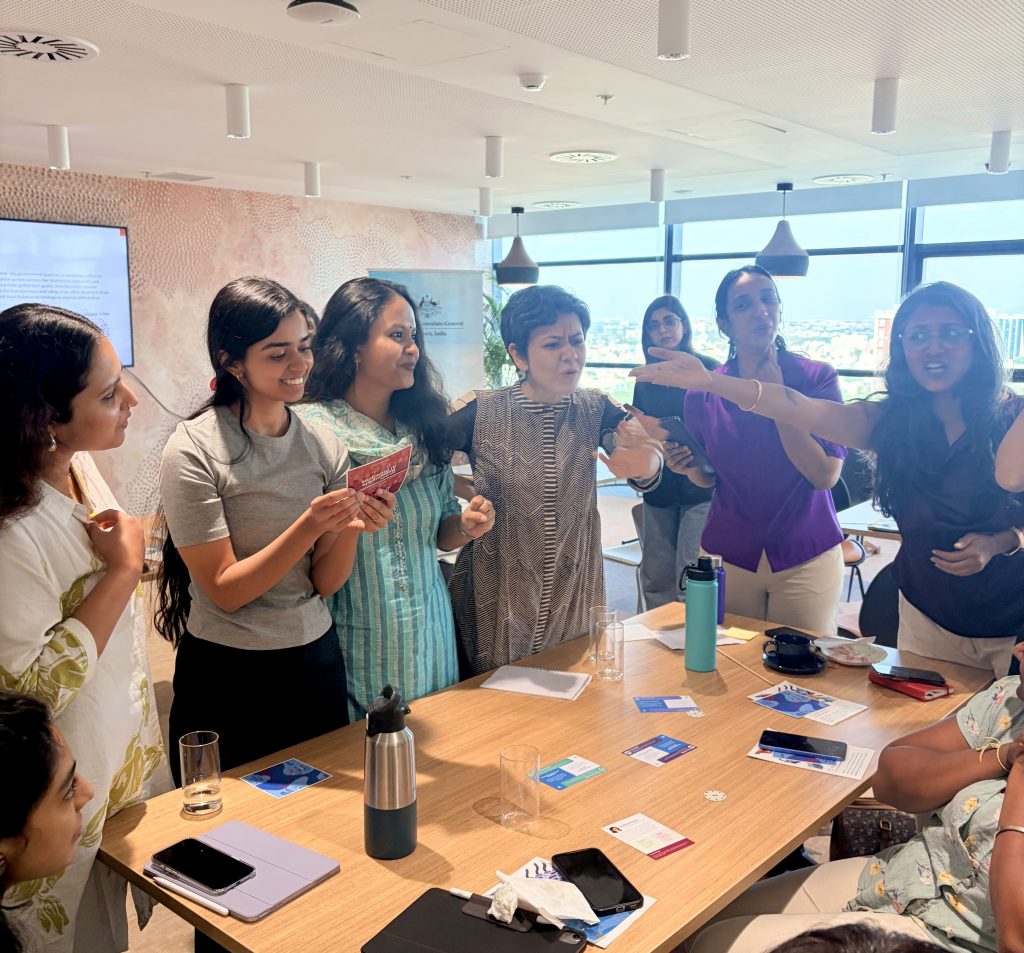
Image source: Madhavi Jain
Description: Participants deliberating during a round of our Responsible AI negotiation -game Souq-on at the Australian Consulate-General in Bengaluru.
At these workshops, play enabled a type of camaraderie that is hard to achieve in formal work settings. We’ve witnessed traditionally competing departments negotiate for other teams; we’ve seen hierarchies flip as industry leaders struggle to pitch to their young colleagues; and finally, participants shifting strategies by improvising, adapting, and overcoming individual and collective challenges when deliberations reach a stalemate. Play makes this possible by giving people the space to do so. It also accelerates the learning and adaptation of policy principles, which helps bridge the gap to real-world implementation.
As a communications specialist, a major part of my role at Aapti is to make our research accessible. We’ve tried to do this by experimenting with formats, mediums, and transforming our expansive research into shorter, snappier monthly newsletters for quick conveyance. With our “games” methodology, we hope to do this via play too. This involves unlocking hidden behaviours in players, rethinking learning as a pedagogy, building capacities to future-proof technology, and most importantly, strengthening awareness on the most urgent policy conversations in the world.
In the weeks to come, we will be hosting many more gaming workshops to try and make our research reach spaces it wouldn’t traditionally occupy. To that end, we’re ramping up our efforts to collaborate with people who’re interested in working towards more accessible, and meaningful digital futures. If this sounds like you, write to us at [email protected] or [email protected] and we’ll take the conversation forward.
Until then, I implore you to try your hand at the Bad News game, created by the Dutch media platform “DROG” in collaboration with scientists from University of Cambridge. The purpose of the game is to immunise the public against misinformation by letting players take on the role of a fake news producer.
You can also read our report which examines how information integrity is moulded within private messaging ecosystems where relational trust, platform affordances, and limited visibility alter how information is interpreted and circulated.