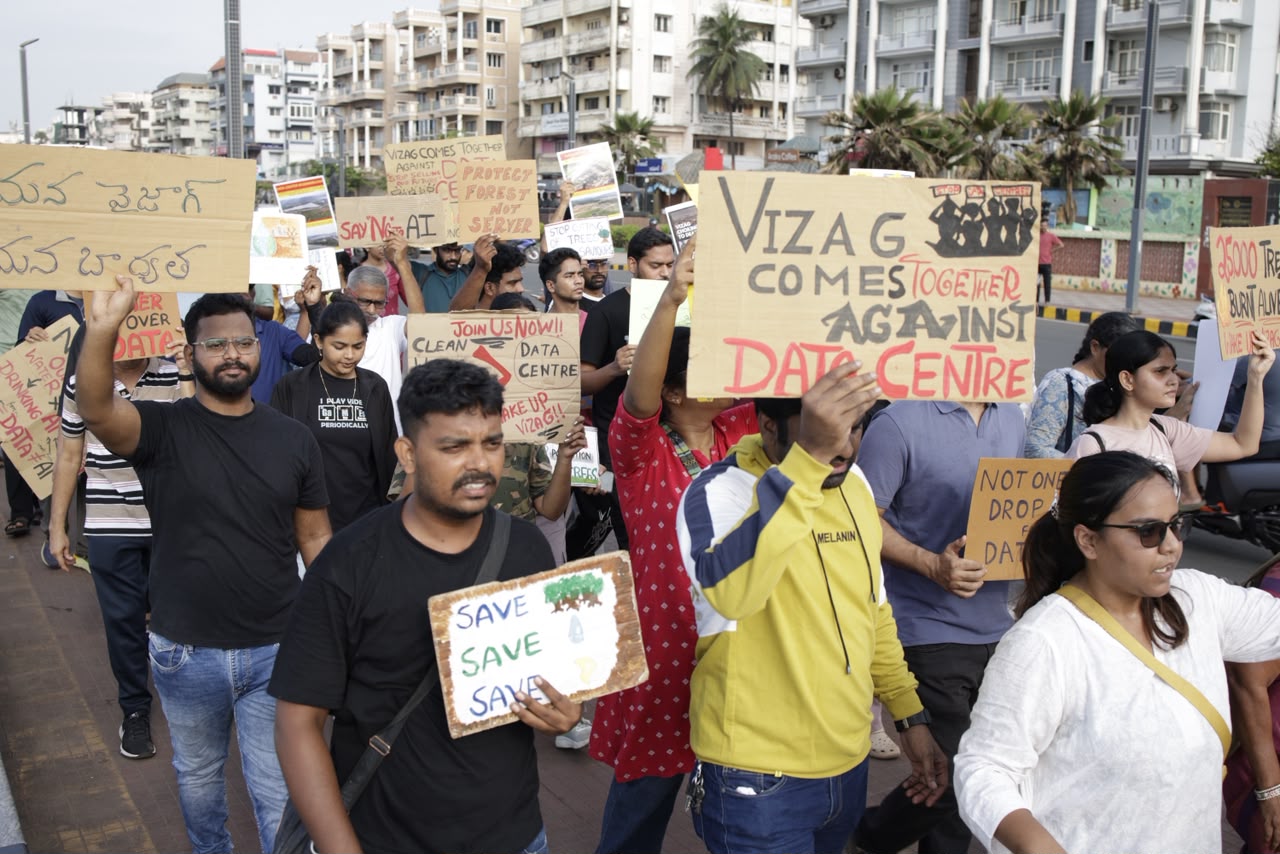
Picture from a rally against data centres on 19th July at R.K. Beach, Visakhapatnam.
Source: Stop Dirty Data Centres
Background
Indian coastal towns are making room for new guests, but not everyone is rolling out carpets to welcome them. For the first time since the boom of Artificial Intelligence (AI), communities are organising on the ground, from Maharashtra to Andhra Pradesh. They deem the rise in data centres as development imposed on them without adequate reparations, and infrastructure built without the consideration of the grassroots. Fuelled by the global collision of technological giants, industrialists, governments and other actors, AI infrastructure is scaling rapidly, forcing communities to negotiate for access to the very land, air, and water that sustain them. In Vishakhapatnam alone, 8.7 gigawatt facilities are being built on 2,151 acres of land. Three of these 13 facilities are being developed by Google and Adani. In Thane, Amazon Web Services’ (AWS) have proposed a hyperscale data centre in Balkum, which protesters say is within a 2-3 km radius of multiple schools, hospitals and residential complexes. While both these movements against data centres are in distinct states with varying demands, they address a twin cause built of the same sense of desperation and deprivation: when do communities get to participate in decisions around India’s ambitious AI dreams?
Disconnect between reality and theory
Prime Minister Narendra Modi’s inauguration note at the India AI Impact Summit in February this year invited the “whole world’s data to reside in India.” By the end of the Summit, American hyperscalers like Google, Microsoft and Amazon invested $67.5 Billion to build AI infrastructure in the country. At the time of these announcements, meant to position India as a future-forward AI hub, critical voices from the ground were either missing or subdued given the loud cha-ching of foreign investment.
But we’re already seeing roadblocks. Videos from people-led movements in Thane and Visakhapatnam are making the rounds on Meta platforms and garnering millions of views. In one such reel from Visakhapatnam, Sohan Hatangadi, an environmentalist and President of the Greater Visakhapatnam Citizens Forum, stands a few hundred metres away from the proposed location of the 512 MW Google-Adani data centre and claims that the data centre will hardly employ 500 people and its monetary revenue returns will only be seen after 35-40 years. He says, “Meanwhile, heat emissions and water shortage will ruin the green cover of the town.” The video ends with him demanding transparency from the actors involved and highlights that the communities are not a part of the decision making process yet.
The dissonance is hard to miss given that none of the people involved in the resistance to data centres in Vishakhapatnam were present at the AI Summit in New Delhi. This stands in direct contradiction with the core, thematic framework of the AI Summit, designed in the form of seven chakras. Each chakra was supposed to “foster multilateral collaboration on AI’s societal impacts, from building skills to ensuring ethical deployment,” but whether it could accurately do that or not is an answer that changes based on who you’re asking. What can be said with certainty, however, is that India’s AI ambitions are seeing the repercussions of divorcing policy from practice with conflicts arising across geographies. The country’s big push to digitalise, hyperscale and become a future-forward AI hub remains disconnected from its realities on the ground.
That India is shifting from merely being a provider of IT services and coding to now owning technological infrastructure is crucial. But that shift hasn’t entirely allowed citizens collective agency and bargaining power in systems that extract from them yet. The foundation stone of India’s growth journey relies heavily on trust between various actors and underestimating it can send us back in the same loop we’ve been stuck in for years: development on paper, but hindrance on the ground. These development projects are rarely just about scaling infrastructure, they alter molecular aspects of a community’s existence including livelihood, resources, and autonomy. The environmental concerns being brought up around data centres by communities represent an urgent sense of existential anxiety many have with these projects. If people have to look at development as something they have a stake in, rather than one that is imposed on them, their involvement cannot be seen as an optional feature by the state. The most important question that arises is: What can policymakers urgently do to ensure that all actors involved in the data centre boom of India have a seat at the table?
Some of this can be learnt from the movements that have come before us. We’ve seen countless resistances across continents: in the United States of America, Canada and Mexico in North America; Brazil, Chile, Uruguay in South America; Netherlands and Ireland in Europe; South Africa in Africa; and Malaysia and Singapore in Asia. The trajectories of these movements can be a nudge for India to build its own knowledge systems and improved accountability measures around data centres.
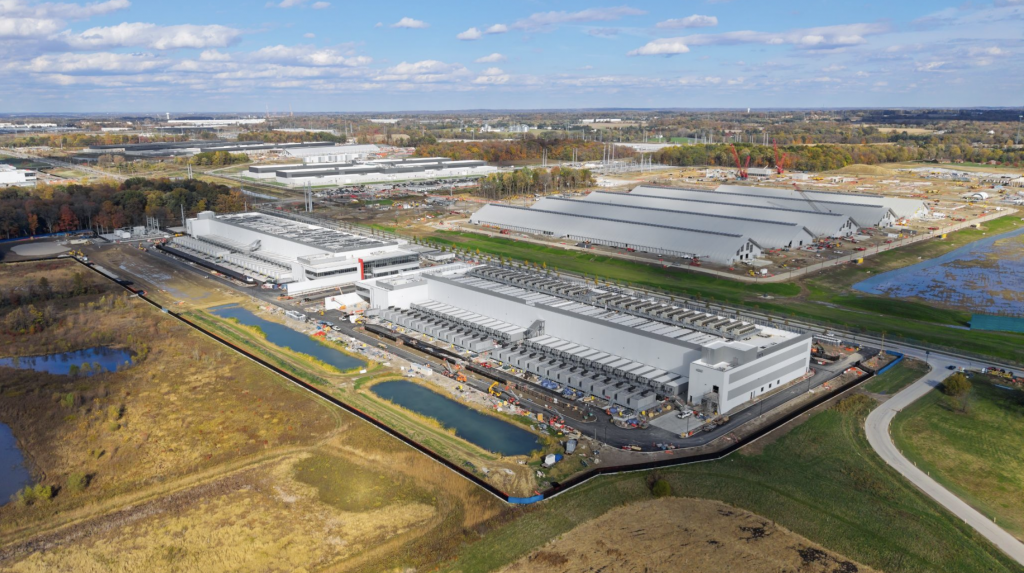
Large data center complex under construction in Ohio
Source: Snehit | Adobe Stock
Lessons to learn from data centre resistances in Global North
Over the past year, the United States has seen a surge in short-form videos from rural communities documenting the impact of data centres in their “proverbial backyards.” Earlier this year, when Gallup asked a national sample of Americans whether they would support an AI data center being built in their local area, 71% of Americans disagreed. Most of the respondents pointed to the environmental impact of data centres including extra-ordinary water and energy consumption patterns, land occupation, noise and air pollution, followed by the lack of consent of communities involved.
A quick search for the terms “data centres” and “dirty water” surfaces hundreds of reels, many of them clipping U.S. Representative Alexandria Ocasio-Cortez (AOC) holding up a glass of contaminated water during a session while discussing Meta’s data centre in Georgia. Across states in America, resistance is becoming more coordinated and increasingly widespread. Yet the response has often deepened, rather than resolved, tensions. In some instances, opposition to data centre projects has even been characterised as “anti-tech extremism,” creating a new fault line between citizens and the state.
Higher up in Canada, resistance is growing with massive protests taking place in Vancouver and other areas. The administration has tried to counter that by raising nationalistic concerns meant to deter Canadians: the need to move away from foreign dependence on AI infrastructure. But citizens are fighting back, even threatening electoral risk to politicians who commit to hyperscale data centre development without proper regulatory frameworks in place. A recent Angus Reid poll reported that 68 per cent of Canadians object to a data centre being built near them.
Heatwave-ridden Europe with over 3,000 data centres, is also seeing spurts of local agitation spring up in Italy, UK, Spain, Netherlands, and Switzerland. With the region witnessing increasingly hot summers every year, power grids are strained and an energy crisis awaits. Cities like Frankfurt, which initially welcomed billions of dollars worth of foreign direct investment for data centres are still waiting to see adequate returns. They seem to have been only left with “noise and concrete” so far.
The material realities of the Global North and Global South are not the same. In India, till now, the dissent is largely curtailed to the question of compensation for land acquisition, which has historically been a tricky topic to navigate. Noted by the Centre for Policy Research, “Disputes over state acquisition of land in India, that deprive people of their land rights, span various dimensions of economic, social, and political life.” Land is not only viewed as an economic resource in the country, but is central to the history, cultural heritage and identity of its people. The meaning of legacy for many indigenous communities equates to the continued sacredness of their natural, and life-giving environment.
While resistances in India are talking of displacement and job creation, the concerns over environment and labour conditions read more like an undercurrent for now. The country also has a very pertinent invisibilised layer of caste, that shapes questions of politics, access and representation. Frontline Magazine reported that in the case of Vishakhapatnam’s Tarluvada, “the Dalit political leadership is split along political lines.” Matters are complicated with the “sarpanch and the eight ward members of Tarluvada belonging to the Open Category (OC) and Other Backward Classes (OBC) communities siding with the panchayat resolution in favour of the Google subsidiary project.” The members of the Dalit community opposing the Panchayat resolution fear facing the brunt of resisting.
In Brazil, indigenous communities are putting things in far more stern terms: calling large-scale data centre projects on their traditional lands an “invasion,” equating it to Spanish colonisation. In Chile, the resistance saw a rare outcome, with local activists successfully forcing Google to halt construction over concerns the site could exacerbate water shortage in a region already under a mega-drought. In South Africa, activists are attempting to invoke the memory of the dreadful “Day Zero” day in 2018, when water restrictions would have led to municipal water supplies being largely switched off and urging the government to rethink the proposed Equinix’s data centres in Cape Town. As of July 2026, municipal authorities in the city have approved their development.
The number of data centres in the Global South are negligible compared to how many are in the Global North. India, for instance, only has about 150 active data centres, compared to the US and Europe, with over 4,000 and 3,000 each. Much of our understanding about them is limited with not enough data to measure their impact. So, resistances to data centres are only taking a skeletal form yet. But this marks a crucial time for us to shape the way we want conversations around technological and digital sovereignty, development and inclusion to go. This is the time when key lessons and knowledge from the Global North can be shared and amplified.
Pitfalls of development without public consultations
We have seen across the Global North that there are real economic losses attached to data centre projects being delayed or axed, going into billions of dollars. These stem from both construction plans falling through to the missed technological revenue. In the USA alone, dozens of plans for datacenters were killed or delayed earlier this year.
With India already battling grave economic inequality, the government must shift its lens by viewing communities as equal and important stakeholders in technological and infrastructural development. Open dialogue with locals around data centres presents an opportunity to circumvent economic losses caused by deliberations and litigation delays. It is even more important to consider the serious environmental challenges that activists and locals have been flagging around the building of data centres. Drastic contamination of land and water, along with concerns over energy and noise pollution, make the data centre debate an issue of mammoth consequence. To that end, accountability measures are non-negotiable if India has to keep up the commitments it has made on global stages regarding AI.
Unlike the Global North, where systems for public consultation and institutionalised criticism are comparatively more established, India is still evolving mechanisms through which local communities can constructively influence infrastructure decisions. Grassroots governance mechanisms are present (in the form of panchayats and gram sabhas), but not always accurately represent community sentiments (as in the case of the caste dynamics in Tarluvada). Therefore, it is important to strengthen our AI policy itself. This gives India and other Global South nations an opportunity to chart a different course than the Global North.
Creating a new faultline between the citizens and the state by repression and calling resistance “anti-tech extremism” cannot be a mistake India makes. It must avoid repeating the all-too-familiar trajectory of antagonising dissent instead of fostering urgent and well-intentioned dialogue.
An opportunity to listen
Movements across the world are teaching us that circumstances turn sour when there is a deficit of trust between communities and the state. This is especially true when locals fear that large actors do not have their interests at heart. They are less likely to feel heard under a trust deficit, and more likely to respond with suspicion. This absence of trust comes at a greater cost than many anticipate. As mentioned earlier, AI infrastructure built with a trust deficit not only causes delay in projects but also severely exacerbates environmental concerns in an already climate-stressed country like India.
Public accountability around data centres becomes indispensable here. As more and more data centres spring up across India, data around their impact must be made transparent. Recently, an RTI filed by an activist in Andhra Pradesh around a data centre project was rejected by the High Court on grounds of confidentiality. A viral investigative video, which crossed 2.6 million views on Instagram, on the impact of the Visakhapatnam data centre on the Dalit communities in the area was blocked in India by Meta on the orders of the government.
Communities are repeatedly doubling down on the demand to be made a legitimate part of the decision-making process. They’re asking for a complete and fair access to information, opportunities to participate before decisions are finalised and access to credible mechanisms to raise grievances and seek redressal.
Public consultation cannot be seen as “procedural hurdles” after approvals have been granted, but as a part of how AI infrastructure is designed and governed. As Algorithm Watch writes, “technological and digital sovereignty includes consent and participation of citizens.”
For organisations like Aapti Institute, this is precisely where our work lies: to think deeply about what meaningful public accountability measures can look like in the AI age, which enable progress accompanied by community rights. This moment is a reiteration of what has been said multiple times before: if India hopes to position itself as a global AI leader, its greatest innovation may not be the speed at which it builds AI infrastructure, but the democratic institutions it builds alongside it.