
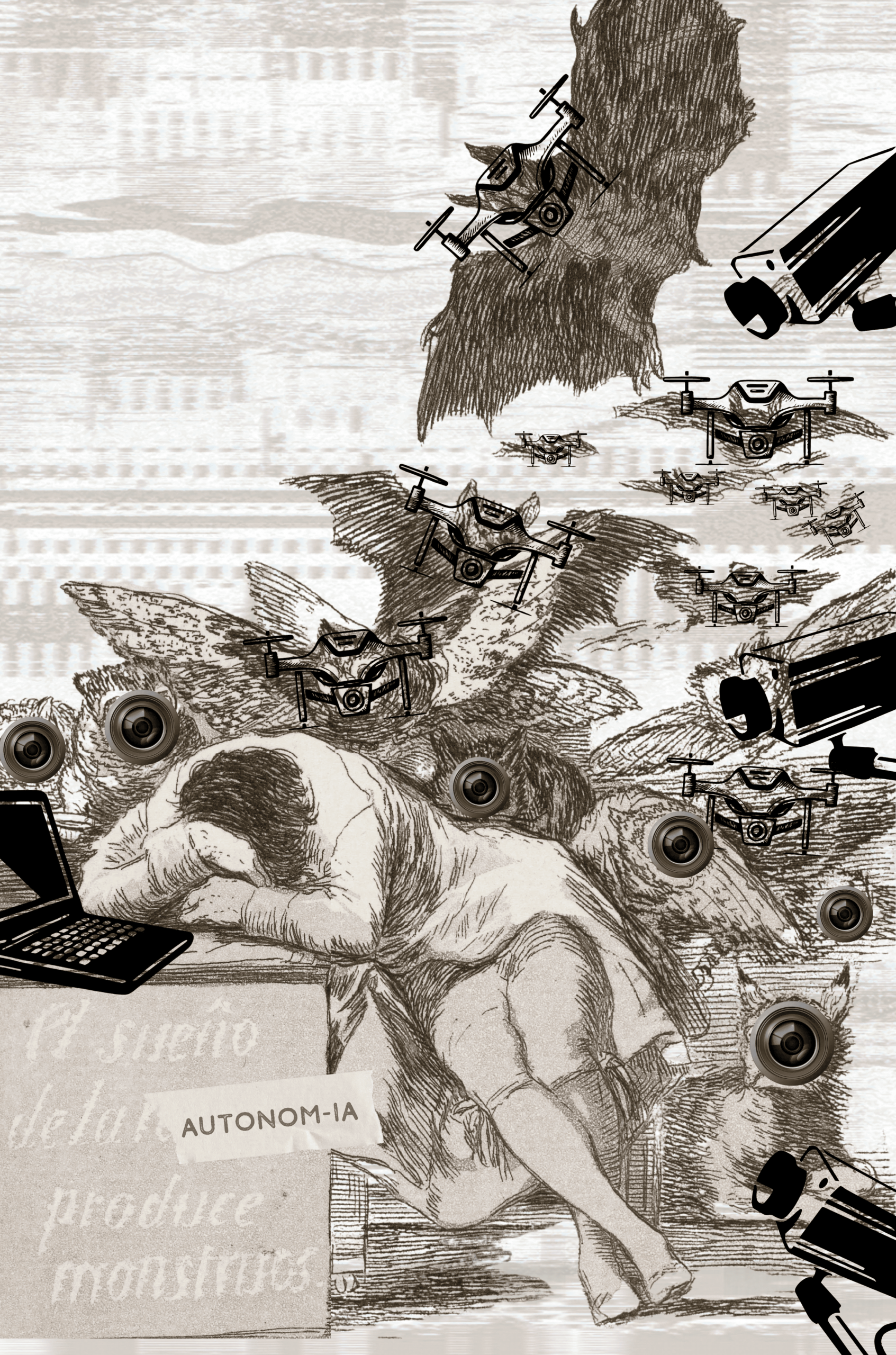
Image sourced by betterimagesofai.org
The artificial intelligence (AI) industry has seen explosive growth in the past few years, with exponential investments pushing frontier developers to move faster than ever. This leads to a prolific increase in the need to train the models. Reinforced Learning through Human Feedback (RLHF) is one method of training, done by millions of data annotators all over the world. Annotators take an output provided by an AI model for a certain task, rate the quality of the output, and provide reasoning for our ranking. This data is then used to fine-tune the model’s capabilities. This aspect of annotation formed the core of my work as a former data annotator. Through this essay, I aim to showcase the internal workings of one of these aggregators and take you through my personal experience. This is one part of data annotation, and there are other methods of annotation work that help develop a model using a human-in-the-loop.
As a journalism student, when AI was first expanding, I witnessed how it affected the jobs of my peers who had to aggressively implement AI in their workplace and redefine their roles. This pushed me to explore the field of AI regulation and safety—both as a career and a responsibility. I viewed annotation work as first-hand experience providing real industry insight into the rapidly advancing world of technology and thereafter, AI policy and governance.
Over the past few months, I freelanced with a third-party company providing ghost work, hired by the frontier AI developers to train their models, for close to two months as a data annotator. Essentially, we are the two-factor authenticators of various AI models. The AI model is already trained with capabilities, and we are the check on its functional capabilities, or lack thereof. Annotators are the cornerstone of building AI, they are what allow an AI to convert raw, unstructured data into actionable knowledge.
Quality annotation is vital to the development of frontier model capabilities. Without accurate annotation work, there is a direct impact on the quality of the model, but more importantly, inaccurate annotation can cause a ripple effect that can lead to dangerous consequences. A bad annotation that fails to mark an output as toxic or wrong could result in the model propagating it upon user request. As people are also prone to bias, it is imperative that the data is annotated by a diverse group of workers who are based all around the world.
The rapidly growing market size for tools that assist in data annotation, like labelling, tracking and text annotating tools, are an indicator of the importance of the process. However, the growth in the industry is extremely lopsided, with stark payment discrepancies between workers in the US versus those in African and Asian countries. The outsourced labour provided by annotation workers dictate the quality of the models being built, which affects the third-party company hiring annotators, frontier models that develop because of it, and customers who use and implement AI in their personal and professional lives. It is the foundation of many billion-dollar AI models.
A peek into the Hiring Process
I had applied to several data annotation jobs, and every single one of these hiring posts on various sites were teeming with applications—be it in work requiring coding skills, or a good grasp on language—there seemed to be no shortage. Some hiring posts even had over 1,00,000 applications. This was not entirely surprising, considering that the work hours were flexible i.e. you could work whenever you wanted, as long as you gave the hiring company a particular amount of hours in a day, and the work required only a basic knowledge of the English language, grammar, and a computer.
The hiring process was long and cumbersome with multiple applications and tests that included detailed comprehension, listening, grammar, writing work, alongside interviews taken entirely by AI. The process seemed endless. A part of this was expected, due to the extensively large pool of eligible workers all over the world. Shortly after, I received an email in my inbox from one of the companies, inviting me to interview for a data annotator role. The pay was 350 INR per hour ($3.7/h).
The next few steps in the process looked like this:
- Similar to other third-party annotation companies, this company also needed me to fill out an extensive profile on their platform, including information on education, work experience, bank details. Once filled, I had access to any and all freelance jobs in their network, which consisted of more annotation and AI development roles like providing regional language expertise, image tagging work. With the significance of data labour, the extent of information required without access to benefits that an employee would receive was concerning. Moreover, the compensation was disproportionate to the value of the work, and the annotators received no form of recognition.
- There was a test to check task readiness attached to the email, through which they taught and evaluated core skills, involving basic annotation and writing. Questions ranged from comprehension, listening, writing, grammar, and other foundational elements of the English language.
- Then there was the “interview” process. They got over 50 applicants on call with the HR person, who briefed us about the role and then asked us to introduce ourselves in 30 seconds one-by-one. This was to understand our hold on the English language so that they can filter candidates to the next process.
- Their hiring pipelines were unstructured. They spent the first 20 minutes clearing out people from the Zoom call who had already attended the “interview” (presumably already filtered out), but still received the meeting link.
- There were people who had diverse experience and qualifications—doctors with 10+ years of experience, even candidates with Masters and PhD degrees. This was a glaring reminder of the large talent pool in India versus the lack of job opportunities across multiple fields, and why data annotation companies can attract so many profiles at relatively low wages.
- There were concerns raised about the lack of clarity throughout the whole process. None of us knew how many steps it would take to actually get to the role. There were lengthy tests without any feedback or comments on performance or their future with the company. When confronted by people who had already taken the test, the HR person dismissed the concerns , “If you have a problem with it, leave.”
- The next round involved a 2-hour test with well over 100 questions. The focus was on the various processes of annotation work, like prompt writing, rationale evaluation, pairwise comparison, and image visualisation. The HR person had mentioned that this would be a paid assessment, with a specified amount never mentioned. To this day, I haven’t received any payment for the test and there is no real way to escalate this matter. Workers are given no option for redressal as superiors refer you to the finance team, who in turn are unapproachable and unresponsive.
- Once the test was done, a background verification was conducted. Curiously, the background check came after clearing all the other tests.
- Finally, I received a contract on the website where I had initially given my information. It cited the agreed pay and all the conditions, and after a few days I was onboarded to work on the website.
The Work
Once onboarded, all the work was on the platform, which the company claims is owned by the client. It was supposedly a highly intelligent tool that tracks the hours that you are actively working through availability and activity. It does this through monitoring the time you actually spend on the platform (even if you have to search something up, they recommend using split screen as switching tabs will stop tracking). This tracking is paramount, as it is the primary and perhaps solitary proof of your work hours. All tasks and models trained by annotators are on this site. Every annotator is assigned a team lead, who sends a daily mail detailing the tasks that you can enter (active tasks) and ones you explicitly cannot.
Take this example: You are allotted an image such as a table or a scene in nature. The image will mask a particular subject. For example, if the subject is a flower, all the flowers will be masked and numbered. To begin with, I write expressions that apply to certain flowers, and then select only those. I could say ‘the yellow flower’ and select only the yellow flowers. Then I have to write expressions that apply to none of the present flowers. This phrase cannot be unrelated to the image, and should be confusing for the model. I could say ‘A yellow flower being held by the child’. There could be a child holding a flower but it is violet. The quality of your statement defines the annotation process. The tool also ensures that it does not let your sentence through unless you have used the main subject. For instance, if my statement was ‘A child wearing a yellow shirt’, it would not have let it through as I did not use the subject in the sentence i.e. flower.
There isn’t a great deal of clarity about the sourcing of footage and images and no way to determine its rights and consent. While a lot of the image data contains faces that have been blurred out for privacy, this is not always the case, with some faces shown clear as day.
No working day is the same. Some days there may be 3 active tasks, out of which 2 may be on the dashboard, some days there may be 7 active tasks but none of them are on your dashboard, so you have no choice but to wait. For example, in your allocation emails it states that tasks X, Y, Z are active, but on the dashboard you can only see task A, which you don’t have clearance to work on. So now you cannot log any hours for the day unless the active tasks appear. And almost every day the tasks keep shifting, the tasks active today most likely will not be active the next day. There are over 200 total tasks that cycle throughout, so the task at hand is purely based on what the client needs at that particular time.
Annotators start their days not knowing whether they’d have any open tasks, and are also faced with possible termination everyday—the company states that if the client’s work is done, the job may disband any day with no prior warning. The employment status is highly unstable and takes advantage of the desperation of many people trying to make ends meet.
The more curious aspect is the extensive training, unique to each task. Every task varies in its requirements: some require you to have a conversation between two models and rate which performs better, some need you to rate the facts a model spits out based on a source image, some require you to verify and correct section-by-section captions generated by AI for videos, the list goes on.
Understandably so, each task has separate training material and a requisite assessment that must be passed with over 80% before you can actually work on the task. Once the assessment is passed, there is a second assessment on the client tool as well, which tests the same knowledge with different questions, failing which blocks you from the task. The catch here is that while the time spent on the second assessment on the client tool (assumedly, there is no way to verify this) is counted towards the hours, the initial assessment is unpaid, with only actual work being remunerated.
It is to be noted that some tasks have training material that could be over 15 pages, and since tasks are cycled every day, an average annotator would spend a great deal of time doing multiple assessments in a single month, and they do not pay for the training, only the work you do after passing training. If you spent time reading, understanding the rules and then failed the assessment, tough luck, your time is down the drain.
Subsequently, the complexity of a task can vary significantly, and there are audits conducted (seemingly at random). For example, 4 annotations that you did for one task on Tuesday can be audited and the scores sent to you. There is a 1-5 scale rating for every target and 3-5 is the range a rater is expected to be in. Compared to actual output, the amount of work audited is minute. To provide a verifiable scale, during my three months of annotation work, during which I did thousands of annotations for various tasks, a mere four annotations got audited one time. That being said, they have the task created in such a way that they can catch usual errors such as spelling, phrasing issues.
The actual work, as mentioned above, can range wildly based on what model is being trained on a particular day. My assigned team lead sent me an email everyday in the morning, citing the tasks that were active, the tests I needed to take and pass in order to be eligible to work on them, and the do’s and don’t’s of the workflow. Once I took the test, I needed to ping the lead and get confirmation that I have passed. All tasks have average handling times which states the amount of time (e.g., 15 minutes) you can spend per output. For example, if there are 25 facts about an image that the model has generated, you have 15 minutes to rate them before moving on to the next image with X number of facts. They push the team leads to ensure that everyone follows the average handling time and that annotators don’t spend more than the average time on one annotation. An important note is that even in one single task, every annotation may not take the same amount of time, but the recommended handling time stays uniform irrespective of this. For example, one of the annotations could need to verify 9 facts given by the AI based on an image of a warehouse facility, and the next one could need a verification of 19 facts based on the UI of a website’s homepage. With that said, there isn’t a major role played by the team lead in the actual work you put in, which is learned through the guidelines, training, and ultimately, practice.
There is a weekly threshold of hours you can work, which falls below 50. The enticing aspect of the work is undoubtedly the flexibility. You can work an hour in the morning, two in the afternoon, two at night and it all counts, making it the perfect moonlighting job. They recently added a time tracker extension that is for internal purposes. This must be turned on while working on the tool, and it is used to track the active tab and time spent on each tab. How or if this affects the working hour count of annotators is undisclosed.
Financials
Finances are handled on the company website itself. There are significant delays in payment for work, as noted throughout the data labour industry, your work in July will be remunerated well after a month. The first time you ever receive a paycheck is months after the ordeal of hiring, unpaid training, and a whole month of actual work. Although the payments are informed to carry such a delay, it is still daunting to have done a substantial amount of work before any compensation. The process is incredibly bureaucratised and is a common issue raised by annotation freelancers, although it may vary from company to company. The company that hired me as a freelancer and is legally obligated to pay me, takes a backseat on how that amount is actually calculated. The tracking of time spent working, the only proof of work and source of compensation for an annotator, is supposedly managed by a tool that is operated by their client.
To make matters worse, the hiring company tells us there is no way to dispute the hours that the tool claims we’ve worked. The annotators are therefore stuck in the middle, as the company cedes responsibility of time-tracking and the requisite compensation to the client, who ironically is completely out of reach for the annotator. This isn’t a one-off incident, it is a problem by design, meant to deter annotators from raising an issue. Once the process comes to an end, the worker is disillusioned to the point of incapacity. They would rather forego the compensation owed to them, than to face legal troubles with a multi-national corporation overseas. Although this is the case, I can attest to the settlement of their dues.
The company clearly states that the hours recorded in the client tool are final, and that recalculations or adjustments will not be made, and the hour data being sent to you is purely informational – what you see is what you get. On a personal note, I had self calculated my July working hours to be 60, based only on time spent on the tool. My “actual” working hours were calculated as 53. Although not a colossal difference, there is no way to dispute this, which means I get paid for 53 hours no questions asked. They also mention that their client manages this platform, and any system tracking or recording issues are beyond their control.
Reflection and Ethical Questions
The time pressure on the job is evidently because the company pays on an hourly basis and they do not want to pay raters for any more time than required, which pushes an annotator to get through tasks quickly rather than taking their time to truly evaluate and accurately rate the model’s responses. Compounding over millions of annotations, this could result in a serious quality concern in training the model. Annotators aren’t afforded the luxury of time for more complex annotations because of the standardised time for tests – audits of quality are rare, scattered and random, and they don’t feel as consequential as they should. The butterfly effect of quantity over quality for shareholder value could prove to have subtle but real effects on a deployed model.
The foundation of these freelance companies, and by association the frontier developers, is the outsourced labour. Their working freelancers seem to be primarily sourced from South Asian and African countries, with India being a hub. The current working market of India makes it ideal to pick up freelancers with foundational skills at an absurdly cheap rate. India boasts of one of the highest working populations in the world, second only to China. Coupled with a severe lack of job opportunities and general living costs, it becomes a hub for cheap labour. While the situation seems to be win-win for a company that needs talent and the working class that desperately need jobs, there is a significant upperhand held by these companies and any others that will fulfill their service needs with the Indian working population. This power imbalance could require analysis and requisite governance to avoid exploitation. Already, the processes being unusually long, the unpaid consistent training, and the financial aspects are at a stage that I believe, as a former data annotator, needs to be monitored.
Editorial Note: This piece is an external contribution that has undergone minimal editorial revisions by Aapti Institute. It is part of our ongoing effort to amplify independent voices, particularly those of individuals whose labour sustains digital systems, and to bring greater visibility to their work. The views and experiences expressed in this piece are solely those of the author and do not necessarily reflect the views or institutional positions of Aapti Institute.
About the Author
 | Easwar is keen on exploring the pressing problems of AI Safety and Governance, and aims to leverage his journalistic knowledge to decode the technical world for non-technical audiences. He has a Bachelor’s in Mass Communication and Journalism from St. Xavier’s College, and worked as a Metadata Editor at Nielsen for over a year. |

