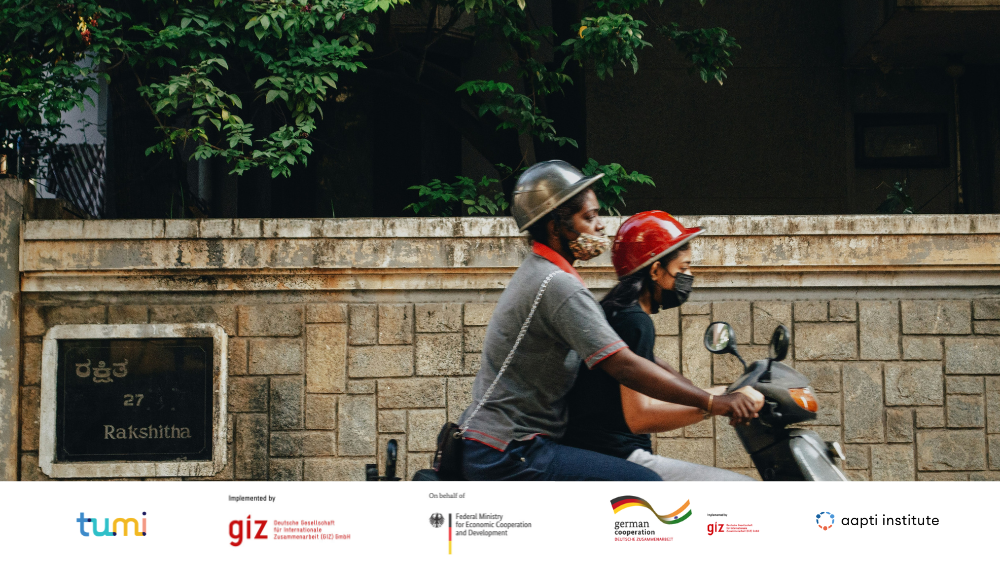
Image credit: Photo by Samyuktha Nair on Unsplash
Bengaluru is home to a vibrant and rapidly evolving mobility ecosystem. Start-ups, researchers, public institutions, civil society organisations, technology companies, mobility workers and citizen groups are experimenting with new ways of moving people and goods across the city. Bengaluru’s wider innovation ecosystem has grown rapidly, with 10,225 startups being founded in the city between 2016 and 2024 only. This growth is also reflected in mobility via multiple initiatives throughout the years, such as the Bengaluru Urban Mobility Lab in 2020 and the Enroute challenge in 2024.
Innovation does not happen in isolation. The ability of these ideas to become useful, responsible and scalable solutions depends on access to data, institutional knowledge, technical expertise, partnerships and, importantly, an ecosystem that can connect people working on related problems. Given the status of Bengaluru’s gridlocked mobility, this becomes even more important.
We are launching a new project to strengthen this ecosystem, with a particular focus on data-driven and inclusive mobility innovation in Bengaluru. The project brings forth a collaboration led by Aapti Institute along with the Transformative Urban Mobility Initiative (TUMI) and GIZ India, through the project Enabling Accessible, Sustainable and Equitable Mobility (EASE), and powered by the German Federal Ministry for Economic Cooperation and Development. This project will bring together two connected strands of activity: a series of three roundtables and a Mobility Innovation Support Lab.
We use a gender-intentional and responsive mobility approach to examine how mobility systems can better respond to the needs, experiences and constraints of women and other gender minorities. This lens will inform our exploration of mobility challenges, data gaps, and opportunities for innovation throughout the project.
Action-oriented Conversations
The first strand of the project is a series of three roundtables bringing together actors from across Bengaluru’s mobility ecosystem. These conversations will look beyond individual solutions to examine the shared challenges that shape how mobility data is collected, accessed, governed and used.
The roundtables will focus on three broad themes: interoperability and data integration, responsible AI and ethical data use, and inclusive and gender-responsive mobility data. Each will bring together perspectives from government, the private sector, academia, civil society, funding partners, technical experts, mobility workers, and other practitioners.
The objective is not simply to create another set of conversations about Bengaluru’s mobility challenges. We want these discussions to help identify concrete problem statements, data gaps, institutional priorities and opportunities for action. Each roundtable will result in a synthesis of the discussion and actionable recommendations, with these insights feeding directly into the next phase of the project.
Bolstering Innovation
The second strand is the Mobility Innovation Support Lab, which will work with one or two selected innovators or projects to translate some of these ecosystem challenges into practical solutions.
The Lab will support innovators with access to relevant data, technical and policy expertise, mentors, networks, and potential funding pathways. Its programme will include hands-on work around strengthening gender based mobility outcomes, responsible use of data, AI, and technology, AI, building viable business and impact models, identifying appropriate data sources, and strengthening solutions against clearly articulated mobility problems.
A key principle of the Lab is that it should not operate as a standalone entity. The problems identified through the roundtables will help shape the selection and support provided to innovators. In turn, the experience of working with innovators will give the wider ecosystem a more grounded understanding of what enables or constrains mobility innovation in practice.
We are particularly interested in innovations that can demonstrate how data and technology can contribute to more sustainable and equitable mobility, including solutions that better account for the experiences and needs of women and other marginalised communities.
Building a community
A central ambition of this project is to build something that lasts beyond its individual activities: a Community of Practice for sustainable mobility innovation.
The Community of Practice will bring together innovators, government actors, researchers, public institutions, technology practitioners, funders, civil society organisations, and other ecosystem actors around these shared questions and challenges. Through virtual sessions and continuous engagement, participants will be able to exchange knowledge, identify useful datasets and expertise, develop partnerships, and connect innovations with relevant institutional and policy spaces.
We see this community as a space for building with, rather than simply advising, innovators. Its value will come from the mutually beneficial relationships it creates. Over time, we hope this can become a community that continues to exchange knowledge and collaborate around Bengaluru’s mobility challenges beyond the formal project period.
What we hope to build
Ultimately, this project is about strengthening Bengaluru’s mobility innovation ecosystem. We want to better understand where the ecosystem’s most important gaps lie, create a shared vocabulary around responsible and inclusive mobility data, connect innovators with the people and institutions they need, and demonstrate practical pathways from problem identification to innovation.
Bengaluru does not lack ideas, technologies, or people working to improve mobility. The opportunity is to connect them more effectively, and to build the conditions in which good ideas can become useful and inclusive solutions.
If you are working on mobility in Bengaluru, building a mobility solution, generating or using mobility data, researching urban mobility, supporting innovation, or simply interested in contributing to this community, please contact us if you would like to collaborate or are interested to know more. You can reach us at [email protected] & [email protected].